fees profitability
Etsy Fees Explained (2026): How Much Does Etsy Take Per Sale?
Learn how Etsy listing fees, transaction fees, payment processing and Offsite Ads affect your earnings. Includes practical fee calculations and profit examples for sellers.
7 min read · SellQora Editorial Team
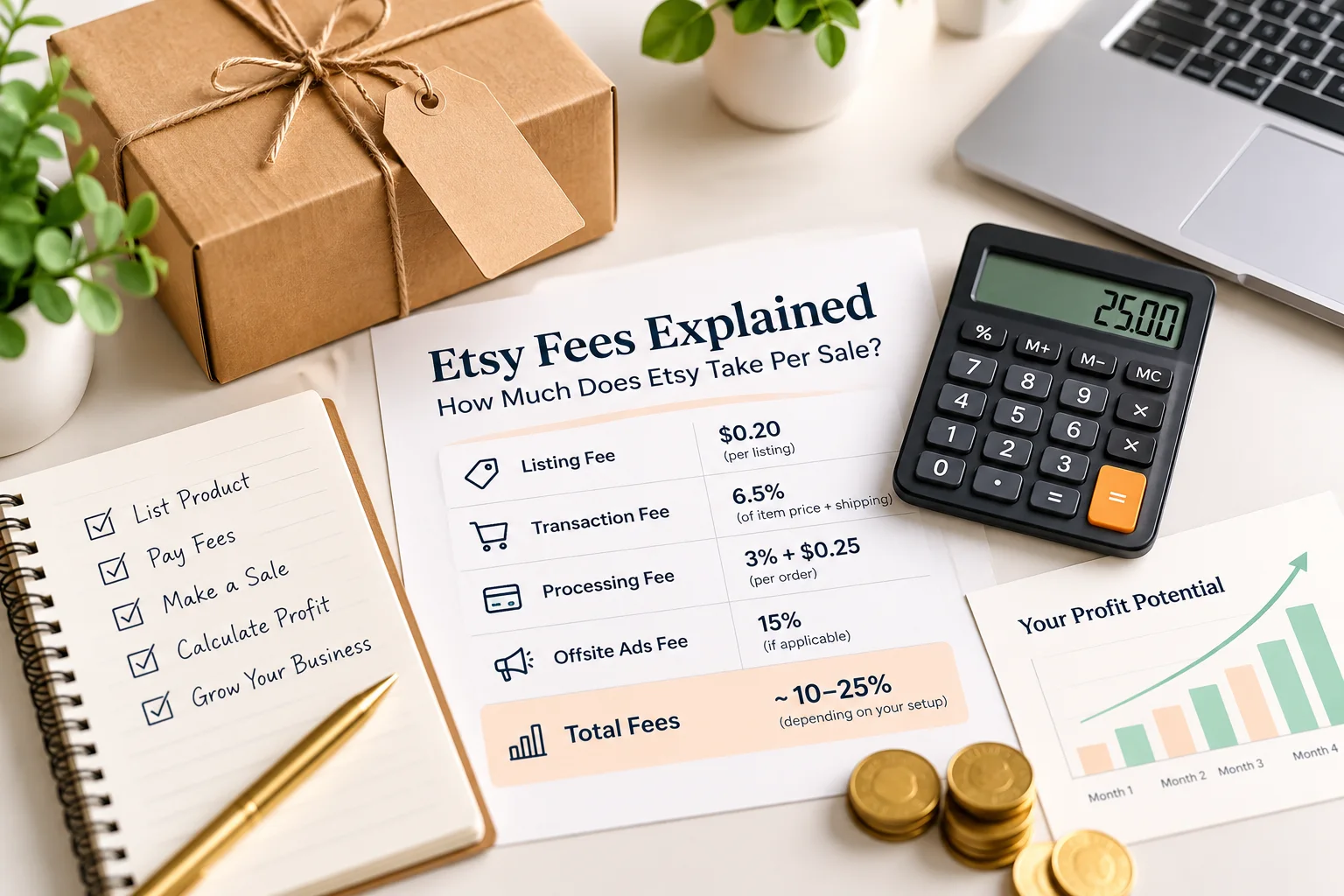
Selling on Etsy involves more than paying a small fee to publish a listing. Every sale can involve several deductions, including transaction fees, payment processing fees, listing fees and, in certain situations, advertising charges.
Understanding these costs is essential because revenue is not the same as profit.
In this guide, we'll explain the major Etsy selling fees, show practical calculations and demonstrate how to estimate the amount you actually retain from an order.
Quick answer: Etsy currently charges a standard $0.20 listing fee and a 6.5% transaction fee. Payment processing fees are additional and depend on your seller bank location. Other charges may apply depending on advertising attribution, currency, location and the services you use.
1. What Fees Does Etsy Charge Sellers?
Etsy has several types of seller fees. Not every fee applies to every shop or transaction.
| Fee type | Standard charge or condition |
|---|---|
| Listing fee | $0.20 USD per listing |
| Transaction fee | 6.5% of the applicable order amount |
| Payment processing | Country-dependent percentage plus fixed fee |
| Offsite Ads | Generally 12% or 15% on attributed orders, subject to Etsy's rules |
| Currency conversion | 2.5% when Etsy's currency conversion is required |
| Regulatory operating fee | Applies in certain seller locations |
Additional expenses may include Etsy Ads, shipping labels, subscriptions and applicable taxes.
Important: Etsy may update its fee policies. Always compare estimates against your actual Etsy Payment account.
2. Etsy Listing Fees Explained
Etsy charges $0.20 USD when you publish a listing.
This fee applies even when the product does not sell.
A listing generally remains active for four months unless it sells out or is otherwise removed. Renewal and additional-quantity charges may also apply.
For example, publishing 100 new product listings creates an initial listing expense of:
100 × $0.20 = $20
That amount is a business expense whether those listings generate sales or not.
For accurate profitability reporting, sellers should track both sale-related charges and listing expenses incurred without a sale.
3. Etsy Transaction Fees
Etsy's standard transaction fee is 6.5%.
It applies to the relevant order amount, including amounts charged to the buyer for shipping and gift wrapping.
Example
Suppose you sell a handmade product for $30 and charge the customer $5 for shipping.
Total order amount:
$30 + $5 = $35
Estimated transaction fee:
$35 × 6.5% = $2.28 (rounded)
A common pricing mistake is calculating the transaction fee using only the product price while ignoring shipping charged to the customer.
4. Etsy Payment Processing Fees
Payment processing fees are separate from Etsy's transaction fee.
They usually consist of:
- A percentage of the applicable payment amount.
- A fixed fee per transaction.
The exact rate depends on your seller bank location.
For example, Etsy's published rate for US Etsy Payments sellers is 3% + $0.25 USD per order.
For an illustrative $35 order, assuming no additional tax enters the processing-fee base:
($35 × 3%) + $0.25 = $1.30
Do not apply the US processing rate to every Etsy shop. Sellers in other countries should use their applicable country-specific rate.
5. How Much Does Etsy Take From a $30 Sale?
Consider the following illustrative scenario for a US-based seller.
Order assumptions:
| Item | Amount |
|---|---|
| Product selling price | $30.00 |
| Shipping charged to customer | $5.00 |
| Total customer order | $35.00 |
| Listing fee allocated to this sale | $0.20 |
| Etsy transaction fee (6.5%) | $2.28 |
| US payment processing fee | $1.30 |
| Estimated Etsy fees | $3.78 |
The transaction fee is calculated before rounding to the nearest cent; the table displays rounded amounts.
In this simplified example, approximately $31.22 remains after the listed Etsy fees.
However, this is not the seller's net profit.
You must still deduct the actual costs of producing and delivering the order.
6. How to Calculate Your Actual Etsy Profit
A practical simplified profit formula is:
Estimated profit = Customer revenue − Etsy fees − Product costs − Packaging − Shipping expenses − Other attributable costs
Let's continue with the previous example.
| Revenue and expenses | Amount |
|---|---|
| Customer revenue | $35.00 |
| Etsy fees | −$3.78 |
| Product production cost | −$12.00 |
| Packaging | −$2.00 |
| Actual shipping expense | −$5.00 |
| Estimated order profit | $12.22 |
This example excludes advertising, refunds, taxes, overhead and other possible expenses. It assumes the listing fee is allocated to this particular sale.
Notice that the seller received $35 from the customer but retained approximately $12.22 in estimated order profit.
This is why evaluating sales revenue alone can be misleading.
7. What Happens When Etsy Offsite Ads Apply?
Etsy's Offsite Ads program can introduce another significant cost.
Under Etsy's published rules, attributed orders generally carry a 15% fee for shops below the relevant $10,000 USD revenue threshold and a discounted 12% fee for shops that have reached it. Participation and eligibility rules apply, and the advertising fee is capped at $100 USD per attributed order.
An attributed order may therefore produce a substantially different profit result from an otherwise identical organic order.
For example, a $35 order subject to a 15% Offsite Ads charge introduces an additional estimated $5.25 advertising expense.
Using our previous simplified calculation:
$12.22 − $5.25 = $6.97 estimated profit
This demonstrates why sellers should calculate advertising scenarios before deciding whether a product's selling price provides sufficient margin.
8. Common Etsy Fee Calculation Mistakes
Several mistakes can distort a seller's profitability calculations.
Ignoring shipping-related transaction fees
The amount charged to customers for shipping can affect Etsy's fee calculations.
Using the wrong payment processing rate
Processing fees vary by seller location. Applying another country's rate produces inaccurate estimates.
Treating revenue as profit
Your actual costs must be deducted before calculating profit.
Ignoring advertising attribution
An Offsite Ads order may generate substantially less profit than an organic order.
Forgetting renewal and unsold listing expenses
Not every business expense is associated with a completed order.
Confusing markup with margin
A 30% markup does not produce a 30% profit margin. These are different financial measurements.
9. Calculate Your Etsy Fees Before Publishing a Product
Instead of estimating profitability mentally, use a structured calculation for each product.
Start with the expected selling price, shipping charged, production costs, packaging, fulfillment costs and applicable marketplace fees.
Then calculate the estimated amount remaining after those deductions.
Use the free SellQora Etsy Fee & Profit Calculator:
https://sellqora.com/tools/etsy-fee-profit-calculator
The calculator helps sellers compare selling assumptions and estimate profitability before making pricing decisions.
Fee assumptions should be checked against current Etsy policies and your seller-specific circumstances.
Frequently Asked Questions
How much does Etsy take from a sale?
Etsy generally charges a 6.5% transaction fee, plus applicable payment processing and listing fees. Additional fees may apply depending on your location, advertising attribution and other circumstances.
Does Etsy charge sellers if an item doesn't sell?
Yes. The standard listing fee is charged when the listing is published, regardless of whether the item eventually sells.
Does Etsy charge transaction fees on shipping?
Yes. Etsy's transaction-fee calculation includes shipping amounts charged to the buyer.
Are Etsy payment processing fees the same worldwide?
No. Etsy publishes different payment processing rates according to the seller's bank location.
How do I calculate Etsy profit?
Subtract applicable Etsy fees, production costs, packaging, shipping expenses, advertising and other attributable costs from the relevant revenue.
Can an Etsy seller lose money despite making sales?
Yes. A sale can generate positive revenue but negative profit when the combined fees and operating costs exceed the revenue earned.
Final Thoughts
Understanding Etsy fees is an essential part of sustainable product pricing.
A product may generate regular sales while producing significantly less profit than expected.
By calculating the full cost of each order, reviewing your marketplace fees and testing different selling-price scenarios, you can make better-informed pricing decisions.
Calculate your next product's estimated profit with SellQora's free Etsy Fee & Profit Calculator.
Sources and further reading
- Etsy Help — What Are the Fees and Taxes for Selling on Etsy?
https://help.etsy.com/hc/en-us/articles/115014483627-What-are-the-Fees-and-Taxes-for-Selling-on-Etsy
- Etsy Help — Payment Processing Fees:
https://help.etsy.com/hc/en-gb/articles/115015628847-What-are-Payment-Processing-Fees-for-Selling-on-Etsy
- Etsy Help — How Etsy's Offsite Ads Work:
https://help.etsy.com/hc/en-us/articles/360000338367-How-Etsy-s-Offsite-Ads-Work
SellQora is an independent seller-software platform and is not affiliated with or endorsed by Etsy.